
Decorating Tips & Tricks, Wedding Cake Decorating
An intro to fondant, CMC powder, and gum paste

Aug

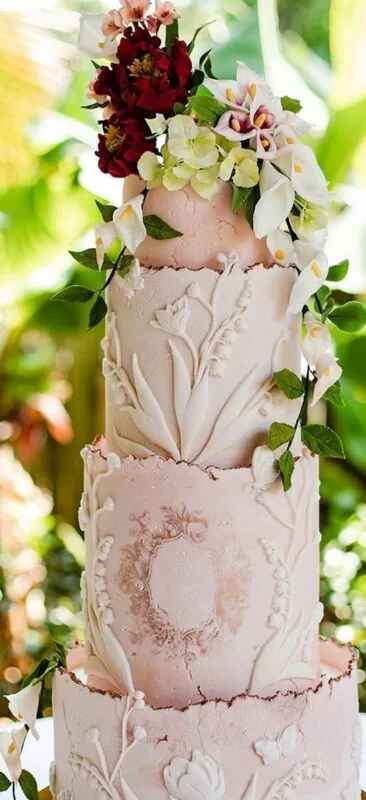
You may have seen it on a wedding cake, or one of those hyper-realistic cakes. Maybe you remember its sugary, paste-like texture when you take a bite of that sheet-like icing. That clean, smooth finish of fondant icing is a staple of the cake decorating world, having been used since medieval times, according to The New York Times. The rolled icing variety, the kind many more people are familiar with, has been around since the mid-twentieth century. Known to be both beautiful and finicky, it has a reputation for being one of the more advanced icings for cake decorating.
In conjunction, products like gum paste and CMC powder stand alongside the sugar dough, all of which are within the same family of sugar dough icings. This is a comprehensive guide to learn the basics of sugar paste, moulding, and what each product does.
The foundations of fondant
Unlike the process of making an icing like a buttercream, most of the time you will probably not need to make your own fondant icing. That doesn’t mean you can just slap it on and be done with it; fondant needs finesse to look its best.
- Tools for the best experience
- Cornstarch/powdered sugar in a shaker/sieve
- This prevents the fondant from sticking onto your work surface and hands
- A 50/50 ratio of cornstarch to confectioner’s sugar yields the best results, according to Wilton
- OPTIONAL: If your fondant keeps cracking, try using a little bit of shortening if it keeps cracking
- Rolling pin
- If you’re always draping it, 17-20 inch rolling pins work best for large projects while a 7-12 inch rolling pin will work for smaller projects
- Small offset spatula/palette knife
- Aids with lifting any delicate shapes off your workspace
- Pizza cutter (preferably something small)
- Makes trimming the access off your cake hassle-free, but a perring knife will work in a pinch
- Paintbrush and water
- Fondant likes to stick to things when it’s wet, so it’s great to use water as a “glue” to hold together your creations together.
- Rotating cake stand
- While not essential for draping, it’s still one of the best tools to have when you’re decorating your fondant cakes.
- OPTIONAL: Non-stick silicone mats
- This would be your best surface to work on for your fondant to keep it from sticking and to prevent any sort of surface defects
- OPTIONAL: Fondant Smoother
- Fondant smoothers help the sugar dough adhere to the crumb coat, but it’s not required
- Your clean hands, a plastic bench scraper, or even a ruler can be used to flatten the surface.
- Cornstarch/powdered sugar in a shaker/sieve
- Prepping the fondant and workspace
- Make sure your work surface is bone dry. Fondant will stick to everything when water is involved, and the best way to prevent the sticky mess is preventing it from happening.
- You can prep the workspace by dusting your workspace with cornstarch to prevent any sugary sticking.
- You could also use shortening if you’re finding that your fondant keeps cracking.
- For draping on a cake: Having both a crumb coat and a full frosting layer on your cake will make a huge difference in the fondant’s appearance
- When you’re placing fondant on just the crumb coat, you will see every bit of that texture underneath. Having the layer of buttercream or ganache in between will improve the overall appearance of your draping.
- Now, you’ve gotten your fondant out of your pail. First, you gotta knead it. It’s a dough, and to be workable, you’ve got to get it ready to use by warming it up slightly with your hands.
- Don’t use something like a microwave oven to heat it up; you could just end up with a soupy mess instead. If you’re finding it difficult to knead, try leaving it sealed in a warm, dry place before using it the next time.
- Dust it with cornstarch/powdered sugar once the dough is pliable.
- A little goes a long way. Using a shaker or a sieve to disperse powder evenly is the best way to dust it.
- Too much can cause it to dry out, making it more likely to crack.
- Make sure your work surface is bone dry. Fondant will stick to everything when water is involved, and the best way to prevent the sticky mess is preventing it from happening.
- Troubleshooting some common issues
The biggest challenge with fondant is that your environment and storage will affect the final product. Things such as your humidity, temperature, and how much you’re working the paste are the largest factors at play.
- Cracking: Cold fondant always cracks. Overkneading your fondant can cause cracking, too. Here’s how to prevent it:
- Bring it to room temperature
- Only knead it until it feels smooth, then stop. Overkneading introduces air bubbles, which can cool into cracks
- Grease your hands and tools with shortening
- Roll to a thickness of 1/8th of an inch or 5 millimetres. Any thinner and it could start cracking
- Lift with your rolling pin
- Smooth from the top down to prevent air bubbles
- If you do get air bubbles, poke them with a knife, then slowly press out the air with your fingers
- You can smooth out small cracks by dipping your finger in shortening before rubbing it into the fondant in circular motions. Larger cracks can be patched using a fresh piece of fondant and smoothing it over the crack
- Elephant Skin: This happens when the fondant is overworked or too dried out, which shares the same issues with how cracked fondant happens. The best thing to do is to cover it up with other decorations.
Paneling and stiffening: CMC powder
If you’re using it to panel a cake, these guides on how much fondant to use and how to panel fondant from Satin Ice are excellent for beginners to learn how to roll out and drape their cakes. But fondant isn’t just for panelling; it can be moulded and cut into different shapes for all your project needs.
However, fondant out of the pail isn’t always the best for sculpting or moulding due to its softness. This is especially the case with softer fondants like Satin Ice: Tropical Rolled Fondant and Virgin Ice Rolled Fondant. This is where CMC powder comes in. Known by other names such as Tylo or Tylose powder, carboxymethyl cellulose helps firm up sugar paste to make it easier to sculpt. It can also be used as a glue to stick pieces of sugar paste together when mixed together into a slurry with water and applied with a paintbrush. Fondant isn’t the only thing you can mix CMC powder with, as gum paste or modelling paste can also be mixed with it, though it often doesn’t require it.
If you’re still curious about how to use CMC powder, this in-depth guide from Crumb Avenue is a great place to start!
Gum paste: fondant’s stiffer sister

If eating the decorations isn’t on the menu, then gum paste is ideal for sculpting edible figurines. It’s occasionally called “flower paste”, since it’s a very popular material for sculpting realistic, edible flowers. It is technically edible, though it’s not suggested to be eaten due to how hard it gets after it has dried out. Fondant, however, will still remain soft even after it has been left out, since it has gelatin as a stabilizer (which is why marshmallow fondant is such a popular recipe). Gum Paste, on the other hand, has a gum-tex stabilizer, making it able to remain stable when rolled even thinner than an 1/8th of an inch.
If you still need pliability, a great solution is to mix some fondant into your gum paste. The ratio of how much fondant you need to mix into your gum paste is based on your project needs. However, this does impact your drying times, as the extra fat will make your sugar paste dry out more slowly. Maybe not the best in a pinch, but it’s great if you need a sturdy project that won’t crack once it has dried out. Sometimes, a mixture of CMC powder and gum paste is known as “modelling paste” in the UK. This is not to be mistaken for modelling chocolate, which is a edible sculpting paste made from chocolate and some kind of sugar syrup.
Brands and Summary
Fondant is excellent for coating cakes, but it’s also a tool that is just as versatile as many other frostings. Its years of history in confectionary had only brought out its full potential in its boom of popularity in the mid-century. With its softness, it can bring a smooth, elegant finish to any cake, able to hold details and shapes buttercream wishes it could hold. To bring it to its full potential as a sculpting material, CMC powder or gum paste can be added to add some stability to the final product. There ae two major brands we carry in particular:
One of the best in the industry, with 25 years of staying power, the brand has built a huge community of dessert decorators, experimenting with the sugar paste in new ways. Offering different formulas to their satin finish sugar dough, a reliable gum paste, and industry standard CMC powder, they are a tried and true pillar of the fondant community.
A newer player to the market that’s Canadian made, Virgin ice is a beginner’s best friend when they’re learning the basics of fondant. Their formula is softer, able to handle the dry weather that is typical up north, with less kneading required. While their catalogue is more fondant focused, they’re slowly building into the leagues of the big players.
It may still be that sweet paste you avoid when you have an extravagant cake, but it’s not going anytime soon. At least, on a personal sidenote, I usually avoid. All products linked are straight to our store, but the information is sourced from different experts all over the globe. If you’re interested in chocolate, check out our article on Compound vs Couverture. Happy baking!