
Decorating Tips & Tricks
Pectin for Pastry
Oct
Pectin & Hydrocolloids in Pastry: Which One Should You Use ?
Which Pectin Should I Use? A Pastry Chef’s Guide to Pectin & Hydrocolloids
Pectin, agar agar, xanthan gum, gellan gum… what do they actually do, and which one should you use?
If you’ve ever stood in a pastry kitchen looking at a recipe that calls for Pectin NH, Yellow Pectin, Pectin X58, or even agar agar or xanthan gum, you are not alone.
These ingredients can look very similar on the shelf, but they perform very different jobs. There has been more than a few times I wish I understood how pectins, and gums went into application and how amazing they are to work with once you understand the science.
As pastry chefs, we don’t choose a gelling or thickening agent simply because a recipe says “pectin.” We choose it based on what we are trying to achieve: a glossy fruit glaze, a firm pâte de fruit, a bake-stable fruit filling, a creamy chocolate glaze, a clear gel, or simply a sauce that needs a little more body.
At Create Distribution, we supply ingredients and tools for pastry chefs, bakers, chocolatiers and passionate home bakers, and one of the questions we hear most often is:
“Which one should I use?”
So let’s make it easier. Be ready for the next 17 minutes better help equip you with the knowledge to use these products.
First: Pectin, Agar Agar, Xanthan Gum & Gellan Gum Are Not All the Same
Before we get into the individual products, there is one important distinction.
Pectin is a specific type of plant-based gelling agent.
Agar agar and gellan gum are also plant-based or fermentation-derived hydrocolloids, but they behave differently from pectin. Xanthan gum is primarily a thickener and stabilizer, rather than a traditional gelling agent.
SOSA categorizes these ingredients separately according to their functions, including gelling agents and thickeners.
That difference matters enormously in pastry.
You wouldn’t use xanthan gum to make a traditional pâte de fruit, just as you wouldn’t normally choose Yellow Pectin to thicken a raspberry coulis.
The best ingredient is determined by the job you want it to do.
The Pastry Chef’s Quick Guide
| Ingredient | Think of it as… | Best for | Thermo-reversible? |
|---|---|---|---|
| Fruit Pectin NH | Your go-to fruit pectin | Fruit glazes, nappage, fruit gels, inserts | Yes |
| Yellow Pectin | Your firm fruit/confectionery pectin | Pâte de fruit, fruit pastes, jams, bakeable fillings | No |
| Pectin X58 | Your dairy/chocolate glaze pectin | Chocolate, nut and dairy-based glazes | Yes |
| Agar Agar | A firm, clean-setting gel | Jellies, clear gels, hot/cold preparations | Yes, but behaves differently from gelatin |
| Xanthan Gum | A powerful thickener/stabilizer | Coulis, sauces, syrups, emulsions | No melting/re-setting gel behaviour |
| Gellan Gum | A heat-resistant gel | Bakeable fruit fillings, hot gels, pastry inserts | Yes |
Important: These ingredients are not always interchangeable 1:1. Dosage, pH, sugar content, calcium, temperature and the final application all affect the result.
1. Fruit Pectin NH
Your go-to pectin for fruit glazes and fruit preparations
If you make modern entremets, fruit tarts or glazed pastries, Fruit Pectin NH is one of the most useful pectins to have in your pastry kitchen.
Fruit Pectin NH is a low-methoxyl amidated pectin designed particularly for fruit and acidic preparations. It is thermo-reversible, meaning the gel can melt when heated and set again as it cools. SOSA specifies an effective pH range around 3.5–3.7 and notes that the product requires added sugar and acid for activation.
What can I make with Pectin NH?
Think:
- Fruit nappage
- Apricot glaze
- Raspberry glaze, Strawberry glaze, Passion fruit glaze
- Fruit inserts
- Fruit gels
- Soft fruit jellies
- Fruit creams
- Some jams and fruit fillings
Pastry chef example
Imagine you’ve made a beautiful strawberry tart.
You don’t want to pour a thick, rubbery jelly over the berries. You want a thin, shiny glaze that enhances the colour and protects the fruit.
That’s where Fruit Pectin NH shines.
It gives you a flexible fruit-based glaze that can be reheated and applied when needed.
A useful starting point
Depending on the desired texture, SOSA lists approximately 0.5–1% for softer glazes or gels and 1.5–2% for firmer glazes or creams. Always follow the specification of the particular product you’re using because different manufacturers can formulate their pectins differently.
Remember
Pectin NH is not simply “gelatin without gelatin.”
It relies on the correct combination of ingredients and conditions, including sugar, acidity, hydration and heat.
2. Yellow Pectin / Pectin Jaune
The pectin to reach for when you want a firm, stable fruit gel
Yellow Pectin, also called Pectin Jaune, behaves very differently from Fruit Pectin NH.
This is a high-methoxyl pectin intended for high-sugar, acidic preparations. SOSA specifies a soluble-solids level above 55% and a pH range of approximately 3.2–3.8. Once it sets, it is thermo-irreversible.
In simple pastry language:
Once it sets, you don’t simply melt it back down and reset it.
What can I make with Yellow Pectin?
This is the ingredient to think about for:
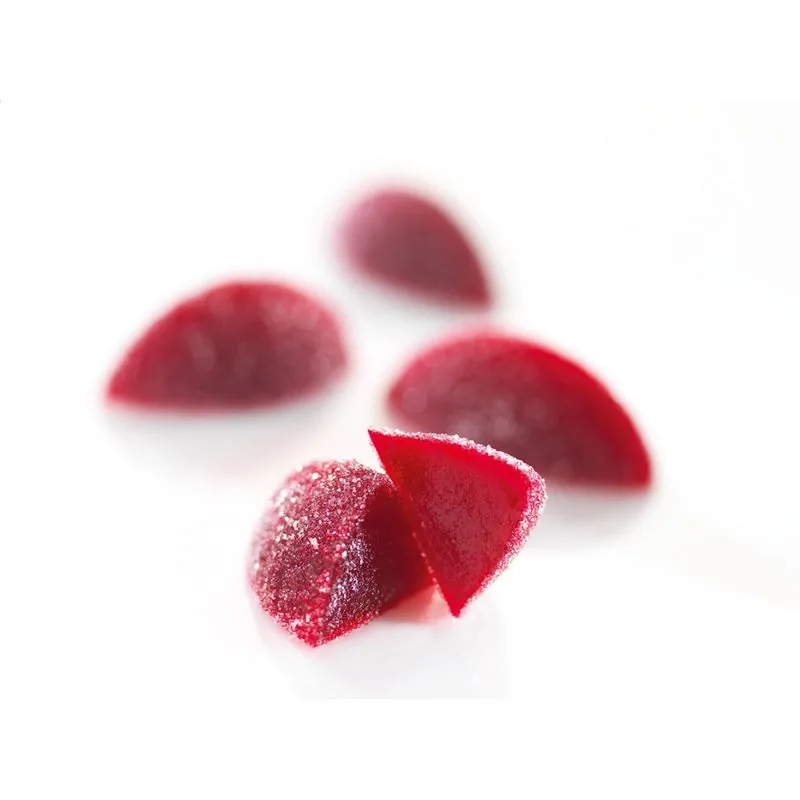
- Pâte de fruit
- Fruit pastes
- Fruit jellies
- Jelly candies
- Firm fruit fillings
- High-sugar fruit preparations
- Certain bakeable fruit fillings
- Jam-style applications
Pastry chef example: Pâte de fruit
One of my favourite examples is raspberry pâte de fruit. You want the finished product to have:
A concentrated fruit flavour + a clean cut + a soft but firm bite + enough structure to hold its shape.
Yellow Pectin is designed for this type of high-sugar, acidic fruit confection.
Unlike Pectin NH, you aren’t looking for a glaze that can be reheated and reused.
You’re looking for a finished gel that stays a gel.
SOSA INSPIRED RECIPE – STRAWBERRY FRUIT PATE
Another important application: bakeable fruit fillings
Because Yellow Pectin creates a thermo-irreversible gel, it can also be useful in applications where the filling needs to maintain its structure during baking. SOSA specifically lists bakeable applications for Yellow Pectin.
Apple turnover → fruit Danish → baked tart → fruit-filled pastry
The exact formula still matters, but this is where Yellow Pectin can become much more useful than a standard nappage pectin.
Professional Tip
Recommended dosage: 1 – 2.5%.
It is advisable to disperse Pectin Yellow with powdered sugar before adding the liquid part of the recipe in order to facilitate dispersion and avoid the formation of lumps. Bring the mixture to a boil, stirring regularly to ensure complete dissolution and hydration. Extend the cooking time until it reaches a minimum Brix degree of 60. Add sufficient quantity of a 50% Citrix solution to reach a pH below 3.5. Immediately pour into the desired container or mould and cool to form a gel.
3. Pectin X58
The pectin many pastry chefs overlook
Pectin X58 is particularly interesting because it fills a very different role from Fruit Pectin NH.
SOSA describes Nappage X58 as a low-methoxyl amidated pectin designed to work in the presence of calcium, and it is particularly suited to fatty and dairy liquids. It is also thermo-reversible.
Where would I use X58?
Think:
- Chocolate glazes
- Chocolate nappage
- Nut-based glazes
- Dairy-based glazes
- Cream-based preparations
- Low-sugar glazes
- Calcium-containing preparations
- Some custard and cream applications
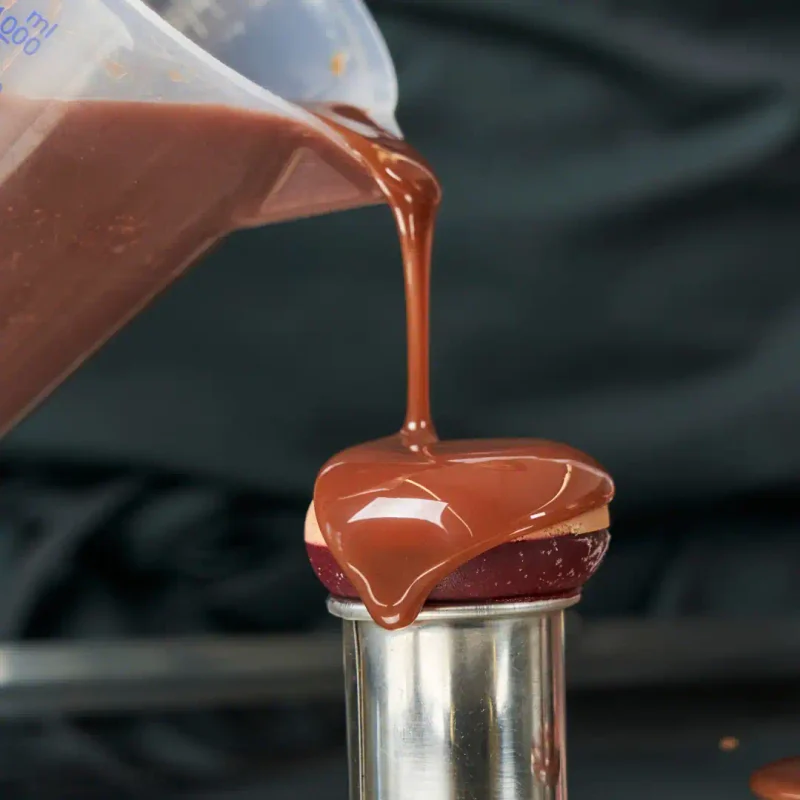
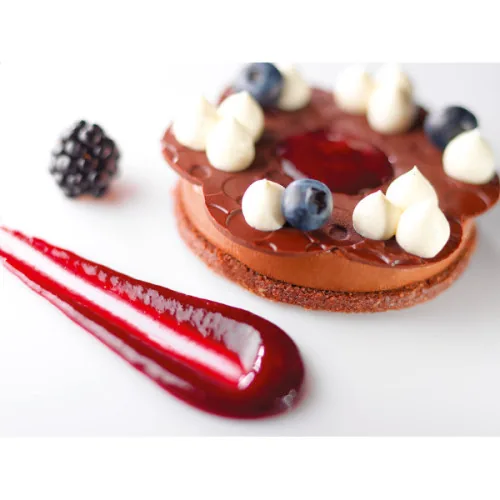
Pastry chef example: chocolate glaze
Imagine you’re making a chocolate entremet.
A traditional fruit nappage isn’t necessarily what you want.
You want a glaze that is:
shiny + smooth + stable + easy to cut + compatible with chocolate and dairy.
This is where X58 can be a better choice than Fruit Pectin NH.
SOSA specifically identifies X58 for chocolate and nut glazes and states that it works with fatty or dairy liquids.
How much?
Mix with the sugar and bring to a boil. Suitable pH > 4. Pectin LM measured with retarding salts. Minimum 50-60% added sugar. Dosage: Gelling glazes (Nappage): 1.3-1.5% Creams and creamy glazes: 1-1.3%
As always, use the dosage supplied by your specific manufacturer.
4. Agar Agar
When you want a clean, firm plant-based gel
Agar agar is not pectin.
It is a plant-derived gelling agent extracted from red algae and behaves quite differently from pectin.
Agar is particularly useful when you want a clean, firm gel with good heat resistance.
What can I make with agar agar?
Think:
- Fruit jellies
- Clear gels
- Jelly cubes
- Fruit gel inserts
- Decorative gels
- Veils
- Caviar-style applications
- Hot gels
- Cold gels
- Some vegan preparations
SOSA indicates that agar is hydrated by heating, then gels as it cools below approximately 40°C. Once set, it can tolerate considerably higher temperatures than gelatin.
Pastry chef example: fruit gel
Suppose you want to make a raspberry gel to accompany a plated dessert.
With agar agar, you can create a clean, sliceable gel that can be cut into cubes, strips or shapes.
However, don’t expect the same texture you would get from gelatin.
Agar tends to produce a firmer and less elastic gel.
That’s why substituting agar agar for gelatin isn’t simply a matter of using the same weight.
One important caution
Agar is not particularly forgiving in frozen applications. SOSA rates its freeze resistance as very low. Acidic preparations can also affect its gelling performance.
So if you’re creating a frozen entremet insert, don’t automatically reach for agar just because you need a plant-based gel.
The application comes first.
SOSA FRUIT AND ROSE ASPIC RECIPE
5. Xanthan Gum
When you don’t actually need a gel
This is where many people get confused.
Xanthan gum isn’t really your “pectin replacement.”
It is primarily a thickener, stabilizer and emulsifying aid.
SOSA describes xanthan gum as working in both hot and cold liquids, with good stability across a broad pH range and strong resistance to freezing and thawing.
What can I use xanthan gum for?
Think:
- Fruit coulis
- Sauces
- Syrups
- Fruit purées
- Dressings
- Emulsions
- Thickened fillings
- Low-viscosity preparations
- Stabilizing frozen preparations
Pastry chef example: raspberry coulis
Imagine you’ve made a beautiful raspberry coulis.
It tastes fantastic, but when you put it on the plate it spreads everywhere.
You don’t necessarily want a gel.
You want the coulis to hold its shape slightly while remaining fluid.
That’s a perfect situation for xanthan gum.
Instead of turning the raspberry purée into a jelly, xanthan can increase its viscosity and give you a smoother, more controlled consistency.
Another example: fruit sauce for a plated dessert
You want your mango sauce to:
- remain fluid,
- coat the spoon,
- hold a clean line on the plate,
- resist separation,
- and remain stable after refrigeration.
Xanthan gum can help you achieve that without creating a traditional gel.
The biggest mistake with xanthan
Using too much.
Xanthan is powerful.
A little can make a big difference, while too much can produce an unpleasantly thick or slimy texture.
SOSA lists approximately 3 g/kg as a dosage for its xanthan gum, but the appropriate amount depends on the application and desired viscosity.
6. Gellan Gum
When your filling needs to survive heat
Gellan gum is another ingredient that can be incredibly useful in pastry, particularly when heat resistance is important.
SOSA describes Gellan Gum as a fermentation-derived gelling agent with a texture similar to agar agar but with greater resistance to high temperatures. It can be used for hot or bakeable gelled fillings.
What can I make with gellan gum?
Think:
- Bakeable fruit fillings
- Pastry fillings
- Croissant fillings
- Cake fillings
- Hot gels
- Fruit inserts
- Firm fruit pieces
- Transparent gels
Pastry chef example: raspberry-filled croissant
Imagine putting a raspberry filling inside a croissant before baking.
The filling needs to:
stay where you put it + withstand oven heat + maintain structure + still taste like fruit.
This is where gellan gum can be very interesting.
SOSA specifically lists applications such as fillings for croissants and cakes because of its resistance to heat.
Agar vs Gellan
The easiest way I explain it is:
Agar: “I want a firm gel.”
Gellan: “I want a firm gel that can take more heat.”
They’re not interchangeable in every recipe, but they can occupy similar territory when you’re working with plant-based gel systems.
Which One Should I Use?
This is the question we really want to answer.
| If you are making… | Start with… | Why? |
|---|---|---|
| Strawberry tart glaze | Fruit Pectin NH | Fruit-friendly, glossy and thermo-reversible |
| Raspberry nappage | Fruit Pectin NH | Excellent for acidic fruit preparations |
| Fruit insert for an entremet | Fruit Pectin NH | Flexible fruit gel with good freeze resistance |
| Pâte de fruit | Yellow Pectin | Designed for high-sugar, acidic fruit gels |
| Fruit paste | Yellow Pectin | Firm, cuttable, thermo-irreversible gel |
| Bakeable fruit filling | Yellow Pectin or Gellan Gum | Choose based on the desired texture and heat requirements |
| Chocolate glaze | Pectin X58 | Designed for calcium-containing and dairy/fat-based systems |
| Nut glaze | Pectin X58 | Well suited to fatty preparations |
| Dairy-based glaze | Pectin X58 | Works well with dairy/fat-containing liquids |
| Clear fruit jelly | Agar Agar | Firm, clean-setting gel |
| Hot gel | Agar Agar or Gellan Gum | Both offer heat-resistant gel systems |
| Raspberry coulis | Xanthan Gum | Thickens without turning it into a firm gel |
| Fruit sauce | Xanthan Gum | Controls viscosity while maintaining fluidity |
| Bakeable croissant filling | Gellan Gum | Excellent heat resistance |
| Bakeable cake filling | Gellan Gum | Designed for heat-resistant gelled fillings |
Can I Substitute One for Another?
Sometimes — but not automatically.
This is one of the most important things to understand about hydrocolloids.
A recipe calling for 1% Pectin NH does not mean you can simply replace it with 1% agar agar and expect the same result.
Even two different pectins can behave differently.
The final result depends on:
- Sugar concentration
- pH
- Calcium
- Water content
- Fat content
- Heating temperature
- Cooling temperature
- The type of pectin
- The concentration used
- Whether the product needs to be frozen
- Whether the finished product will be baked
- The texture you want
This is why professional pastry chefs formulate around the function of the ingredient, rather than treating all gelling agents as interchangeable.
A Simple Way to Remember the Differences
If you’re standing in the pastry kitchen trying to decide what to grab, remember:
🍓 Fruit Pectin NH
“I want a beautiful fruit glaze or fruit gel.”
🍬 Yellow Pectin
“I want a firm, high-sugar fruit gel that stays set.”
🍫 Pectin X58
“I’m working with chocolate, dairy, nuts or a calcium-containing glaze.”
🌱 Agar Agar
“I want a firm, clean plant-based gel.”
🥭 Xanthan Gum
“I don’t want a gel — I just want more body and stability.”
🔥 Gellan Gum
“I need my gel to withstand heat.”
The Most Important Lesson: Choose the Texture, Not the Name
When I teach pastry techniques, I always encourage chefs to start with one question:
“What do I want my finished product to do?”
Do you want it to:
- Pour?
- Spread?
- Coat?
- Set?
- Slice?
- Freeze?
- Thaw?
- Bake?
- Reheat?
- Hold its shape?
- Stay glossy?
- Remain fluid?
Once you answer that question, choosing the hydrocolloid becomes much easier.
For example:
A raspberry coulis that needs a little more body?
Reach for xanthan gum.
A raspberry glaze for a tart?
Think Fruit Pectin NH.
A raspberry pâte de fruit?
Think Yellow Pectin.
A raspberry filling going inside a croissant before baking?
Gellan Gum may be the better tool.
A chocolate glaze for an entremet?
Look at Pectin X58.
Same fruit.
Completely different applications.
That’s the power of understanding your ingredients.
Common Questions About Pectin & Hydrocolloids
Is Pectin NH the same as Yellow Pectin?
No.
Both are pectins, but they are designed for different applications.
Fruit Pectin NH is a low-methoxyl amidated pectin designed particularly for fruit preparations and thermo-reversible glazes.
Yellow Pectin is a high-methoxyl pectin designed for high-sugar, acidic preparations and creates a thermo-irreversible gel.
Can I use Pectin NH to make pâte de fruit?
It is not generally the first choice.
For traditional firm pâte de fruit, Yellow Pectin is specifically designed for high-sugar, acidic fruit preparations and provides a firm, thermo-irreversible gel.
Can I substitute agar agar for pectin?
Not as a straight 1:1 substitution.
Agar and pectin have different activation requirements, textures, setting behaviour and freeze performance.
Agar produces a firmer, less elastic gel and has relatively poor freeze resistance compared with Fruit Pectin NH.
Is xanthan gum a pectin?
No.
Xanthan gum is a hydrocolloid primarily used as a thickener, stabilizer and emulsifier.
It is excellent when you want to increase viscosity without creating a firm gel.
Why did my pectin not set?
There can be several reasons.
Check:
- Did you use the correct type of pectin?
- Was enough sugar present?
- Was the pH appropriate?
- Was the pectin properly dispersed?
- Did you reach the required temperature?
- Was the acid added at the correct stage?
- Did you use the correct dosage?
- Was the recipe designed for a different type of pectin?
Pectin is not simply “add powder and it gels.” The chemistry of the entire formula matters.
Can Pectin NH be reheated?
Yes. Fruit Pectin NH is thermo-reversible, meaning it can melt when heated and set again when cooled. SOSA identifies a thermo-reversible range of approximately 40–60°C for its Fruit Pectin NH.
This is one of the reasons it is so useful for professional pastry glazes.
Which pectin is best for chocolate glaze?
Pectin X58 is a strong option to investigate.
It is specifically designed for nappage applications and is suitable for fatty and dairy liquids, making it particularly useful for chocolate and nut-based glazes.
Which ingredient is best for a bakeable fruit filling?
There isn’t one universal answer.
Yellow Pectin can be excellent when you want a firm, thermo-irreversible, high-sugar fruit filling.
Gellan Gum is another excellent tool when heat resistance is the priority, particularly for fillings that will be baked.
The choice should be based on the final texture and recipe formulation.
Can I use these ingredients in frozen desserts?
Some perform much better than others.
Fruit Pectin NH has high freeze resistance, while SOSA rates agar agar’s freeze resistance as very low. Xanthan gum also performs well through freezing and thawing.
If you’re making an entremet or frozen dessert, don’t choose your gelling agent without considering the freeze/thaw cycle.
The Pastry Chef’s Takeaway
Pectin and hydrocolloids can seem intimidating when you first start working with them.
But once you stop thinking of them as mysterious powders and start thinking about the job you need them to perform, they become incredibly useful tools.
You don’t need every hydrocolloid in your pastry kitchen.
You need to understand which one solves the problem you’re trying to solve.
Fruit glaze? Pectin NH.
Pâte de fruit? Yellow Pectin.
Chocolate or dairy glaze? Pectin X58.
Firm clear gel? Agar Agar.
Thicken a coulis without making a jelly? Xanthan Gum.
Need a heat-resistant gel or bakeable filling? Gellan Gum.
And remember: always check the technical information and recommended dosage for the specific product you’re using. Different manufacturers can formulate similar ingredients differently.
At Create Distribution, we’re here to help pastry chefs, bakers, chocolatiers and passionate home bakers understand not just what is on the shelf, but why and when to use it.
Because the right ingredient can completely change the result.
Explore Pectin & Hydrocolloids
Create Distribution carries professional pastry ingredients from suppliers such as SOSA Ingredients and PCB Créations, giving pastry professionals and passionate bakers access to the ingredients they need to create better glazes, gels, fillings, fruit preparations and desserts. Knowledge is power and after this you will be more confident to try new recipes and taste the results to follow. – Natasha Schick